Search This Blog

Tuesday, 11 June 2013

EIGHT WEEKS TO FAT LOSS WITH MATT ROBERTS

By MEGAN MCCLUSKIE


Tired of hiding my body in oversized tees and slouchy jumpers for fear of revealing an extra few inches, and with the party dress season around the corner, I know it’s time to start thinking about streamlining my shape. And what better way to kick start my motivation levels than with a focused eight week Fat Loss Package at the Chelsea studio of trainer to the stars Matt Roberts, where you might bump into celebrity clients such as the Camerons, Naomi Campbell and Tom Ford.  The main goals of the training package are to decrease body fat percentage, improve fitness and your waist to hip ratio. Using a mixture of resistance training, high intensity interval training, metabolic circuits and intense core training the programme promises to delivers unlike no other.

Sound daunting? It doesn’t get more drastic than signing on with a trainer three times a week when you’ve always preferred the anonymity of a class to the intimacy of one-to-one. Don’t get me wrong, I am not exactly a stranger to the gym and I think the potential to be a weirdo about exercise is there. As a Bookings Editor who sees models on a daily basis, I’m fascinated by their accounts of pre-Fashion Week body-sculpting – tales of 4am starts, brutal diets, two hour long weight and cardio training sessions. I’m even a little envious. But as someone with practically no muscle definition and zero experience of lunges, squats and sit ups I am a little nervous as I make my way to an initial fitness assessment at the Matt Roberts Chelsea branch.

However, I’m immediately put as ease by lovely fitness trainer Laura Hagan as we take initial measurements; BMI, body fat percentage, waist to hip ratio, muscle mass and even hydration levels are recorded. We then move into the gym, which resembles a stylish underground bunker – all dimmed lighting, cool metal tones and mirrors. I am introduced to their ‘Functional Movement Screen’, which identifies exercises that will best restore proper movement and build strength.


My results reveal a normal BMI but a very high body fat percentage so there is serious work to be done. Our plan is: eight weeks, three sessions per week, followed by a couple of cardio sessions outside of my usual PT hours. I’ve chosen to lose my evenings to the programme and am having a little difficulty in bidding farewell to box set nights in and fun nights out in favour of goblet squats and reverse lunges.

No one forces you to exercise as an adult – there’s no obligatory netball, cross country running or hockey lessons, nor compulsory bleep tests every new term. We don’t push ourselves because, well, pushing ourselves can be painful. There’s lactic acid, muscle pain and sweat, and the feeling you might even throw up. Which is why the training package at Matt Roberts works. While it’s not exactly a breezy stroll in the sunshine, nothing is scary and everything is explained with just the right encouragement and pressure from my great personal trainers Laura and Alan. The programme is tailor made to you and you learn how to do the exercises correctly and take them home with you.

Each session starts with a warm up on a foam roller (imagine a soft rolling pin kneading your muscles), which breaks down the lactic acid that builds up in the muscles and causes subsequent aches and tension. And with my muscles aching after the first few sessions, I look forward to hopping on the mat and rolling out any residual soreness.

We then start with a circuit that works on everything from legs and bum, to upper body and the abdominal muscles. Within seconds, I am sweating and red faced from seemingly simple leg rises. I twist from left to right holding a medicine ball, use TRX straps to pull my body through my hands, squat holding a heavy weight - always taking the weight in the heels, attempt incline press ups and finish with an intensive five minutes of interval training on the cross trainer, before the glorious last five minutes of stretching - heaven!

I have to admit, the first week hurts and I feel muscle pain in places where I didn’t even know muscles existed. Sensing I am in trouble, I buy every Radox muscle soak on the market. Yet, after just week one, I already feel stronger, motivated and even though I ache, I feel a little more energised. 
'No one forces you to exercise as an adult – there’s no obligatory netball, cross country running or hockey lessons, nor compulsory bleep tests every new term'
After three initial tough weeks on the Fat Loss training package at Matt Roberts I’m beginning to make progress. I feel at ease with trainers Laura and Alan and they push me in a way that makes me feel positive. However, as friendly as they are, there’s always one more glute raise to be done and an extra ten seconds giving 100% on the spin bike. After I cheerfully keep a conversation going while pulling a weighted cable row, I catch a note being made on my file to increase the weights next time. Apparently, if you can chat away, then you have spare capacity.

You’re constantly challenged as your body adapts. Repetitions of weighted step ups, planks, hamstring curls, dumbbell chest presses and reverse lunges have all been added to the routine, and levels have been increased on the dreaded interval training cardio machines. Interval training is definitely encouraged, as Laura says; “your body uses more calories and oxygen after high-intensity interval training than after steady-state aerobic exercise.” And when the goal is fat loss, short bouts of high intensity exercise are essential and leave the body able to work harder for longer periods of time.

The initial stiffness and fatigue from the first sessions is starting to fade and other than a few late nights doing laundry (I underestimate the sartorial demands of constant exercise and have to stock up on gym leggings and sports socks) I am starting to look forward to frequent exercise. I am certainly starting to discover why people keep going back for more, after all the blood, sweat and tears: exercise can easily become addictive, for many reasons beyond the body-shaping benefits.

After five weeks of training sessions at Matt Roberts, something is happening, the repetitions are gradually becoming easier (muscle memory develops) and knowing exactly what I have to put myself through to burn off the calories, sugary cupcakes and biscuits that regularly – and unhelpfully – orbit the fashion desk are now ignored and avoided. And the thought of having to exercise on a hangover means alcohol is ruled out too. I’m starting to feel cleaner and leaner. Nervous I would stumble during a weeklong work trip in New York (the land of fries, burgers and cotton candy), I receive a sweet email from my trainer with tips on what I could do in the hotel gym to help me stay on track.  I return ready and raring to go for the last few weeks.

The post-sweat dopamine high – though perhaps not as fun as some other highs – is very real - as is the evidence of the toning and tightening of my body. On a recent shopping trip, the sales assistant in the changing room tells me the dress looks too large and I should opt for a size down (and yes, I almost kissed him!) The experience is making me more convinced of the importance of exercise, and I know we are capable of more than we do.

Diet is admittedly still a battle (a lifetime of chips and Wotsits is hard to kick) but with the aid of a food diary and nutritionist advice, the Fat Loss Training Package is more than just personal training – it’s a full service. Clients are advised to follow the food pyramid (see picture) with fibre, pulls, protein and good fats being the sound base of a healthy diet.

 We then start with a circuit that works on everything from legs and bum, to upper body and the abdominal muscles. Within seconds, I am sweating and red faced from seemingly simple leg rises. I twist from left to right holding a medicine ball, use TRX straps to pull my body through my hands, squat holding a heavy weight - always taking the weight in the heels, attempt incline press ups and finish with an intensive five minutes of interval training on the cross trainer, before the glorious last five minutes of stretching - heaven!

I have to admit, the first week hurts and I feel muscle pain in places where I didn’t even know muscles existed. Sensing I am in trouble, I buy every Radox muscle soak on the market. Yet, after just week one, I already feel stronger, motivated and even though I ache, I feel a little more energised. 
'No one forces you to exercise as an adult – there’s no obligatory netball, cross country running or hockey lessons, nor compulsory bleep tests every new term'
After three initial tough weeks on the Fat Loss training package at Matt Roberts I’m beginning to make progress. I feel at ease with trainers Laura and Alan and they push me in a way that makes me feel positive. However, as friendly as they are, there’s always one more glute raise to be done and an extra ten seconds giving 100% on the spin bike. After I cheerfully keep a conversation going while pulling a weighted cable row, I catch a note being made on my file to increase the weights next time. Apparently, if you can chat away, then you have spare capacity.

You’re constantly challenged as your body adapts. Repetitions of weighted step ups, planks, hamstring curls, dumbbell chest presses and reverse lunges have all been added to the routine, and levels have been increased on the dreaded interval training cardio machines. Interval training is definitely encouraged, as Laura says; “your body uses more calories and oxygen after high-intensity interval training than after steady-state aerobic exercise.” And when the goal is fat loss, short bouts of high intensity exercise are essential and leave the body able to work harder for longer periods of time.

The initial stiffness and fatigue from the first sessions is starting to fade and other than a few late nights doing laundry (I underestimate the sartorial demands of constant exercise and have to stock up on gym leggings and sports socks) I am starting to look forward to frequent exercise. I am certainly starting to discover why people keep going back for more, after all the blood, sweat and tears: exercise can easily become addictive, for many reasons beyond the body-shaping benefits.

After five weeks of training sessions at Matt Roberts, something is happening, the repetitions are gradually becoming easier (muscle memory develops) and knowing exactly what I have to put myself through to burn off the calories, sugary cupcakes and biscuits that regularly – and unhelpfully – orbit the fashion desk are now ignored and avoided. And the thought of having to exercise on a hangover means alcohol is ruled out too. I’m starting to feel cleaner and leaner. Nervous I would stumble during a weeklong work trip in New York (the land of fries, burgers and cotton candy), I receive a sweet email from my trainer with tips on what I could do in the hotel gym to help me stay on track.  I return ready and raring to go for the last few weeks.

The post-sweat dopamine high – though perhaps not as fun as some other highs – is very real - as is the evidence of the toning and tightening of my body. On a recent shopping trip, the sales assistant in the changing room tells me the dress looks too large and I should opt for a size down (and yes, I almost kissed him!) The experience is making me more convinced of the importance of exercise, and I know we are capable of more than we do.

Diet is admittedly still a battle (a lifetime of chips and Wotsits is hard to kick) but with the aid of a food diary and nutritionist advice, the Fat Loss Training Package is more than just personal training – it’s a full service. Clients are advised to follow the food pyramid (see picture) with fibre, pulls, protein and good fats being the sound base of a healthy diet.


THE RESULT
Get fit fads and new-fangled routines are all very well but when it comes to exercise – and especially sweating – most of us want one thing: Results. And the results from the Matt Roberts Fat Loss Package are undeniable.

I have lost 12lbs, 5% of my total body fat, two inches from my waist and four inches from my hips. Even more excitingly my body really does look different – leaner and lither. My waist and hips are noticeably smaller. I feel fitter, stronger and more aware of my body. I stand taller.

Thanks to my trainer Laura Hagan’s varied programme, I have also learned a whole book’s worth of exercises I can do at home and am now armed with weaponry to continue the fight outside the Chelsea studio. I now want to exercise on a regular basis, a big step up from my previous haphazard fitness routine of an exercise class here and there. It’s this change that is perhaps most surprising to my family, friends and myself - a change that no measuring tape can track. My trainer tells me that fat burning starts speeding up more - as your body gets leaner; the fat burns off quicker.


Matt Roberts Personal Trainer Laura Hagan’s Five Fat Loss Tips
It’s simple right?
Create a ‘calorie deficit’ whereby you burn more calories (through exercise and basic body function) than you consume.

1. Increase your LPA (Lifestyle Physical Activity)
Throughout your day, simply do more! Start to enjoy the feeling of raising your heart and breathing rate by taking the stairs, not the escalators, wash your own car, not through a car wash and for those at work, use the loo or photocopier on the floor above you! Every little really does help!

2. Book it in!
Use a diary every week to plan and ‘book in’ your exercise. View these as appointments and be sure not to double book! Aim for at least five 1 hour sessions per week, which raise the heart and breathing rates; these can consist of gym workouts, walks in the park or countryside, exercise classes, swimming or even some tough gardening! Make a note about how you felt after the exercise too; this will help to continuously remind yourself of that positive post exercise feeling!

3. Cardio doesn’t have to be boring!
Instead of long slow (some may say boring!) cardio work lasting 20 minutes or more, try interval training. This is where you work for 20s high intensity followed by 40s rest (double the time!) and repeat 5 times.  Do 5 minutes of interval training on the treadmill, x-trainer or rowing machine as a finisher for a workout including big compound moves like squats and lunges. 

4. Write it down!
For 5 days write down everything that you eat and drink. This will no doubt motivate you to eat better in the first place but suddenly the areas of improvement will become clear. Try having a fruit tea instead of traditional tea or coffee…the temptation to also have a biscuit or cake (often at least 100 kcal, which could make all the difference) is massively diminished! Small and gradual changes are the key for maintenance and changing habits of a lifetime! Aim to balance your diet using a wide variety of foods and remember that treats should stick to being treats and not everyday habits!

5. Brighten up your plate and taste the rainbow!
Aim for at least 4 bright colours on your dinner plate, consisting of protein, plenty of veg and wholegrain carbs. Also, try early evening eating not late night feasting; this will avoid heavy meals sitting in the stomach just before bedtime!

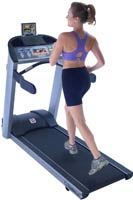
What You Need to Know About the Best Cardio Machines


Your Body is Always Ultimately Going to be the Best Cardio Machine!
Whether a cardiovascular exercise is effective or not has less to do with the machine than you would think. Cardio exercise is not fun for most people, especially avid weight trainers.

The Main Purpose of Any Cardio Machine is to Raise Your Heart Rate

With the best cardio exercises, you are moving the large muscles in your body which require a lot of oxygen. Oxygen is circulated throughout the body in your blood.
When you get your blood pumping, your heart rate rises to pump the blood to your working muscles. If you are out of shape and look to get back into it, your extremities may fatigue before your heart does. If you have the knowledge about which cardio machines are best for your goals, you can maximize your cardiovascular exercise.


How Do You Find Which Cardio Machine is Best for You?

The Best Cardio Machines for Your Best Friend May Not Be the Best for You

You already know that the most important aspect of successful cardiovascular exercise is to raise your heart rate. Even though you can raise your heart rate on any cardio machine, there is a cardio machine which is best for you.

The Best Cardio Machine for You Depends on a Few Factors

Whether You Enjoy it or Not
It may seem amateurish to have such an obvious solution but it is very important to enjoy the exercise. If you enjoy (or hate less) a certain cardio machine, it is best for you. You get absolutely no benefit if you don’t use the best cardio machines.
Whether the Cardio Machine Exacerbates Any Physical Problems
As the old saying goes, “everything in moderation.” It holds true when using the best cardio machines. If you perform the same motion over and over again, it will lead to muscle imbalances, which lead to static and dynamic posture problems. If you sit all day at work in front of a desk, the stationary bike is not the best choice for a cardio machine. If you have extremely bad knee problems the stair master is most likely going to do more harm than good.
Whether the Cardio Machine is Consistent with Your Goals
If you look to burn fat and improve and maintain your cardiovascular fitness, all of the best cardio machines will help you. If your goals are performance related, you should predominantly use cardio machines which most closely relate to your given activity. For example, if you are a marathon runner, the majority of your cardio exercise should be running. This does not mean that you shouldn’t use the stationary bike every so often for the sake of variety and balance.
Whether the Machine is Conductive for a Productive Workout
Even though you can get cardiovascular benefits from any cardio machine, some are just more difficult. Some cardio machines are more difficult than others simply because they force you to remain active instead of be lazy.

Why are There So Many Different Types of Cardio Machines?

Cardio Machines Were First Developed for Training Purposes, Not Fat Burning Devices

Cardio machines used to be predominantly used for training. Treadmills were used by people who couldn’t get outside to run. Rowing machines were used by people who wanted to train their rowing ability without the inconvenience of getting to the river.
Due to changing lifestyle and dietary factors, people started to become overweight at an alarming rate and the fitness revolution happened in the 1980s. Cardio machines were designed to simulate daily physical activities which could be done in place on a machine.
Later on in the 1990s, elliptical machines were designed specifically for non-impact exercise.
Here is an Overview of Cardio Machines You Will Find in a Gym (in no particular order)

Treadmillsbest cardio machines buy a treadmill today

Treadmills are for for the most basic impact exercises: walking, jogging and running. Every quality treadmill has the ability to change the speed and incline (level of hill) to about 10-15% incline. Treadmills usually have safety features such as an auto stop switch and side handles to make sure you don’t hurt yourself.
Another feature of the best treadmills is a remote heart rate monitor. It is not convenient to put your hands on the hand heart rate monitors when you running if you are serious about your exercise intensity.
The best treadmills allow you to put a strap around your sternum which will send your heart rate to the treadmill by remote.
Exercise TipIf you do not like running, walking on the treadmill can be very effective for burning calories and fat and getting cardiovascular benefits. If you choose to walk rather than run on the treadmill, the key is to set the treadmill at a significant incline. Working against gravity will increase difficulty and caloric expenditure.
Do not pull on the handles when you have an incline.. If you grab the handles, it completely defeats the purpose of the incline. The “calories burned” meter on the machine will also be inaccurate. If you feel like you need to hold on for dear life, you should slow down the machine.

Recumbent Stationary Bikes

recumbent bikeRecumbent bikes are the lazy person’s favorite cardio machine.
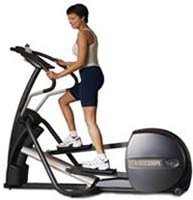
If you make the trek to your local gym, you will definitely see a few people read a magazine while they watch TV and talk on their cell phone on a recumbent bike.
This does not have to be the case. Like any of the best cardio machines, you can elevate your heart rate significantly on the recumbent bike, but you have to put out more effort than you see most folks giving.
Exercise Tips: If you want to get the best cardio workout on a recumbent bike, use one of the hill profiles. These are interval programs which raise and lower the resistance for periods of time, using the principles behind interval training.
At the top of some hills you will want to quit because your legs burn so bad, but just as you are ready to quit, the interval will be over and you will be coasting again.
Make sure you set up the distance to the pedals properly. Your legs should come to almost full extension, but not lock out. If the pedals are too close you will most likely burn out your leg muscles more than increase your heart rate.

Elliptical Trainers

best cardio machine preco elliptical trainer buy nowElliptical machines are famous for non-impact exercise. Non-impact exercise means there are minimal compressive forces on your bones and joints.
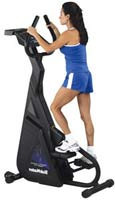
There are two main varieties of elliptical machines. One variety has handles, which allow upper- and lower-body concurrent push-pull movement. The intensity is increased by adding resistance.
The other variety does not have handles and usually allows the incline level of the foot rests to be adjusted as well as the resistance level.
Exercise Tips: Do not make the elliptical machine your only source of cardio. If you perform only non-impact exercise your bone mass and strength, could suffer in the long term.
To get the best workout on an elliptical machine with handles, set the resistance high so you have to use your arms as well as your legs.

Stairmasters / Stair Stepper Machines

best cardio machines buy a stairmaster todayStairmaster is actually just a brand of stair stepper machine. The motion of a Stairmaster is similar to climbing up steps, but your body weight is actually pushing the steps down. If the difficulty of the Stairmaster is increased, the steps will fall faster which will cause you to step faster.
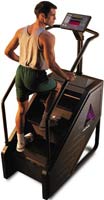
On a Stairmaster, you’re are working directly against gravity and your body weight. Any time a cardio exercise has a vertical component it will be more difficult than horizontal-only activities.
Stairmasters have been known to be hard on the knees. If you have any major muscle imbalances and posture problems the Stairmaster is probably not your best cardio machine.
Exercise TipsLike most of the best cardio machines, it is better for you to avoid overgripping the handles. The handles are for balance only. If you need to support your body weight with the Stairmaster, you should lower the intensity level.
To get the most effective workout on a Stairmaster, use an interval program. As with most cardio exercises on machines, the interval programs will allow you to burn the most calories a shorter amount of time.
Interval programs are great because they work your aerobic and anaerobic systems together, producing a significant effect on your metabolism.

Stepmills

best cardio machines buy a stepmill nowStepmills or Stairmills are like the escalators from Hell. It is just like you are climbing up your local stadium steps, except they are never-ending.
Stepmills are not for the beginner. Even at very low settings, Stepmills get your heart rate up very quickly. When you increase the difficulty level, the escalator goes faster.
Also note that the steps are pretty narrow. If you have feet over size 12, it may be awkward to exercise on the Stepmill. This is unfortunate, because the Stepmill is definitely one of the best cardio machines to get your heart rate up and keep it up.
Exercise Tips: Do not support your entire body weight with the handles. You should hold them for safety reasons, but they are not meant to support your body weight. This takes away from the intended effects of the exercise.
You can also step up sideways both ways on Stepmills. This is a great way to help functionally strengthen your legs’ stabilization mechanism, the inner and outer thighs. Do not try this if you have any ligament problems in your knees.

Adaptive Motion Trainers

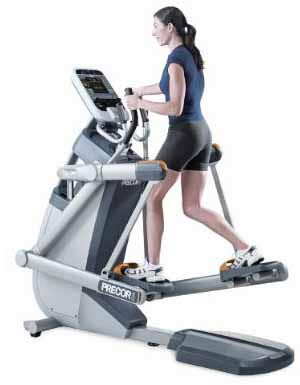
Precor Adaptive Motion TrainerAdaptive motion trainers are a fairly new type of exercise technology. Two of the original brands are the Precor Adaptive Motion Trainer and the Technogym Vario.
Adaptive motion trainers represent the evolution of cardio machines and a huge step up from elliptical and arc trainers due to the freedom of movement.
As the name suggests, adaptive motion trainers adapt the motion of the exercise to your movements. Rather than traveling in a same motion such as an ellipse, you are free to move whichever way you like.
While there is some limitation, you can perform movements ranging from stepping up and down, to short-stride rowing, to long-strike running and elliptical-like motions.
All this freedom comes with a price, as these types of the best cardio machines are very expensive and the price is unlikely to come down until there is more competition.
Exercise Tip: Get the most out of the adaptive motion trainer by varying the types of strides you take. Since you can perform different types of motions, and you have control over how long you perform them, use the timers on the machines programs to avoid performing too much of a single motion. This will encourage a more balanced workout.

Versa Climbers

best cardio machine versa climberThe Versa climber is one of the best cardio machines you have never heard of. If you do have a Versa climber in your local gym, you’ll notice that it tends to be one of the least popular cardio machines. It may even be collecting dust. That’s a shame, because it truly is one of the best cardio machines out there.
The Versa climber is such a good cardio machine because you are climbing vertically, directly against gravity. You also use your upper and lower body equally, which increases heart rate quickly.
To increase the difficulty of the versa climber, you can add more resistance. When you add more resistance, you can push and pull, which will not only work your muscles, but will give you a tremendous cardio workout.
Exercise Tip: The versa climber is a fantastic cardio machine to use for interval training. At a decent intensity level, the Versa Climber can be tough even for just 5 minutes.
It is possibly the best cardio workout to alternate a few minutes on the Versa climber with a couple minutes on a stationary bike or any other cardio machine to which you can make a quick transition, never allowing your heart rate to drop.

Tread Climbers

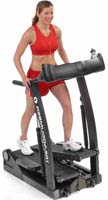
tread climber cardio machine buy one from amazon now!The treadclimber is one of the newer cardio machines to hit the market. Upon its release, there were immediate claims that it was one of the “best cardio machines,” but its popularity never really took off. This is likely because the treadclimber is an awkward combination of a Stairmaster and treadmill.
This cardio machine has independent treadmills which raise and lower every time your foot strikes. There is no running on the tread climber, only walking, which makes it a comfortable way to burn calories if you are significantly overweight.
Exercise Tips: The up and down motion of each independent treadmill is not controlled by the machine but rather the strikes of your foot. Unless you want a wild, unproductive cardio workout make sure you plant each foot evenly and don’t stomp.
Like most of the best cardio machines, you should not support the majority of your body weight on the handles. Because of the awkwardness, make sure you hold to the handles when you first try the tread climber.

Incline Trainers

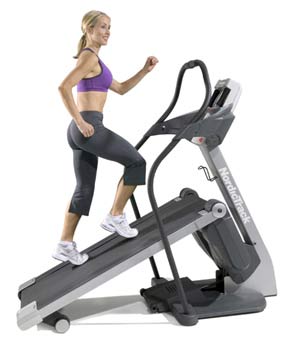
Incline TrainersIncline trainers are simply treadmills with the ability to increase the incline past the usual 15% all the way to 30-40%.
Having a higher maximum incline allows you to burn the same amount of calories walking on a high incline than jogging or running on a lower incline. This makes incline trainers the best cardio machines for people who don’t like running or jogging.
While the amount of calories burned is always going to depend on the effort you exert, many people are uncomfortable running, which makes incline trainers superior to standard treadmills as they will allow you to burn more calories walking.
The incline trainers also allow more advanced exercisers the ability to exercise at higher intensities and inclines, which is important for people who train for hiking and other high incline, high intensity events.
Exercise Tip: As with regular treadmills, the handlebars are mainly present as a safety precaution to aid balance. Holding on and leaning much of your body weight with the handles defeats the purpose of increasing the intensity of the machine. If you find yourself holding on the handles for dear life, lower the incline or speed, or choose a different cardio machine.

Stationary Bikes

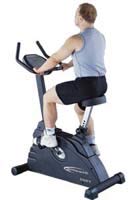
stationary bike cardio machine buy one from amazonThere are about a million different models of stationary bikes. Stationary bikes are upright with no back rest. Every gym in the world has at least a few stationary bikes.
The way to increase the intensity of a stationary bike is to increase the resistance of the pedals. Most stationary bikes have many different programs.
Some programs increase the resistance at preset intervals and some depend on your heart rate as the cue to increase resistance. The programs which use your heart rate increase the resistance to keep you at your target heart rate. The machine usually determines your target heart rate for you from the information which you input before you start the program.
Exercise Tip: Make sure you sit upright and do not slouch when using the stationary bike. If you work a job or live a lifestyle where you sit for many hours during the day, you should probably not use the stationary bike. Choose a standing machine instead.
Your hip flexors are most likely tight, which would cause posture problems if you overdo workouts on the stationary bike. The best cardio machines can hurt you as well as help you.

Fan Bikes

Airdyne Bikes
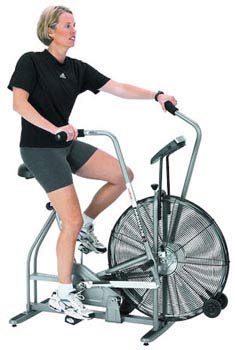
The Schwinn Airdyne exercise bike was the first patented fan exercise bike to provide a full total body workout. They were brought on the market in the 1980s and have endured to this day.
“Fan bikes” or “dual action bikes” made by other brands are often referred to as Airdyne bikes after the Schwinn model, which has been around the longest.
Airdyne bikes are an upright exercise bicycles which incorporate arm movement. The exerciser has to push and pull to aid in moving the machine at higher resistances.
The giant fan which is powered by your feet pedaling and arms pushing and pulling blows at the exerciser which can be great during difficult, sweaty workouts.
Exercise Tip: Since Airdyne bikes are designed with concurrent upper and lower body in mind, performing one at a time is not the best way to use them. Set the resistance level high enough to where you cannot perform the exercise comfortably without using your arms. Now you will get the most out of the Airdyne bike, as you are using your arms as well as your legs.

Rowing Machines

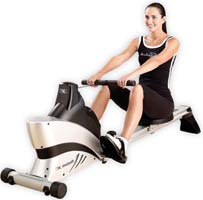
rowing machine buy from amazon and get one at homeThe rowing machine is the most underrated cardio machine in the gym. Most people do not understand the correct way to use the rowing machine.
Rowing machines are obviously the best cardio machines for simulating rowing but they are great for cardio as well if you know how to use them.
Rowing machines are not meant to be a resistance exercise. When people improperly use them they are usually pull very hard with their arms and have bad form.
The difference between rowing machines and all other cardio machines is you are in complete control of the intensity of your session. The faster you go, the more intense your cardio workout will be.
Since you must have motivation and put out effort to get the full benefit from rowing machines, rowing machines are not the most popular cardio machine among the many people who like to read magazines or watch TV while exercising
Exercise Tips: To get full cardio benefit of the rowing machine, you should use one of the built-in programs. These programs will show you intervals which allow you to pace yourself so you don’t get burned out too quickly.

Arc Trainers

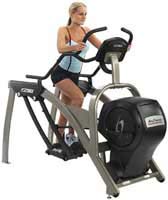
Arc TrainerThe arc trainer is another non-impact cardio machine. They are one of the newer types of cardio machines in your local gym and are probably most popular.
You step on two platforms and basically swing your legs back and forth in a similar fashion to the gazelle freestyle, which has been a top selling home workout machine for many years.
The adjustable resistance as well as the speed at which you choose to swing your legs back and forth in the scissor-like motion adjusts the intensity of your cardio workout.
Exercise Tips: Non-impact machines are the best cardio machines for people with chronic joint problems. The arc trainer can get your heart rate up effectively without putting too much stress on your legs.
Don’t let the non-impact style cardio machine sabotage your results. Make sure you work hard and keep your heart rate up higher than your target zone. If you are free of joint problems, make sure you also use forms of impact exercise such as jogging to keep your bones strong and your bone mass at optimal levels.

Hand Ergometers

Click Image to Buy Online
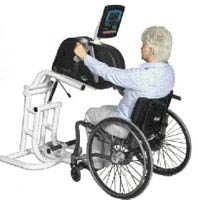
Hand ergometers or hand bikes are not anybody’s favorite cardio machines. When you are forced to use a hand ergometer it usually means you either have a broken leg, sprained ankle, surgically repaired knee or are bound to a wheel chair.
Hand ergometers can actually get your heart rate up faster than leg cardio machines because your arms are closer to your heart than your legs.
Hand ergometers have been used often in research about heart rate response.
Exercise Tip: Think happy thoughts. The hand bike is not very fun and can be quite boring. Very few people choose to use the hand bike as a form of cardio.

Why Row?

Row to lose fat and get fit with little impact

Rowing is a complete form of exercise. Rowing's combination of cardiovascular and strength conditioning make it a great addition to any fitness or training program for people of all ages, and with a wide variety of fitness goals. People we know who benefit from the machine range from Olympic rowers to 90 year olds; from international rugby players to couch potatoes; from people recovering from major operations to people determined to keep middle age spread at bay.

The Ultimate Exercise


It is rare to find an activity that works as many muscle groups through as wide a range of motion as rowing does. Knees, hips, arms and shoulders will each see 90 - 130 degrees of rotation in every stroke, which is more than you’ll find in most other aerobic activities. This greater muscle involvement makes rowing a great calorie burner, while also developing flexibility and strength. Rowing is impact-free, and the intensity is completely user-controlled. Thousands of customers have found rowing to be the best low-impact, full-body workout available!

Weight Loss

The full body rhythmic nature of rowing makes it wonderfully efficient at burning calories without putting a lot of stress on your legs and feet.

Injury Rehab

The low-impact nature of rowing makes it a great way to rebuild muscle tone and strength while increasing mobility and flexibility after an injury.

Cross-Training

The physical benefits of rowing are a natural complement to many sports such as running, swimming, cycling, tennis, rugby, motorcross or virtually anything else, making it a great way to cross train during the off-season.

Lifetime Fitness

Whether you’re 9 or 90, already fit or getting fit, rowing offers a superb aerobic workout to help you achieve your fitness goals.

Competition

Originally designed as a training tool for world class rowers, the Concept2 Indoor Rower continues to serve as a powerful off-water training tool for competitive rowers at all levels around the world.

Rowing Works the Whole Body

Legs
Each rowing stroke involves full compression and extension of the legs, working the muscles of the calves, thighs, hamstrings, buttocks and hips. And because it’s low impact, it’s much easier on your knees than most activities that build leg strength.

Core
Rowing is one of few exercise modes that will work your “core” abdominal and back muscles. Fitness experts believe a strong core yields numerous benefits, from a stronger back to better posture.

Upper Body
Rowing will strengthen and tone your upper body. Shoulders, back and arms are all involved in the rowing stroke.

Heart and Lungs
Because it engages so many muscle groups simultaneously, rowing puts a healthy demand on the cardiovascular system resulting in improved cardiovascular health.

More Reasons to Row

Submitted by customers...

  • Rowing is a Lifelong Sport - Folks of all ages can do it: from kids to grandparents.
  • Rowing is a time-efficient workout.
  • To reduce stress and anxiety.
  • To keep in shape for surfing, mountain climbing, swimming, running, cycling.
  • "Makes me feel great!" - promotes well-being and self-esteem.
  • Weight loss, blood pressure reduction.
  • For relaxation and meditation, to clear one's mind, to help one sleep.
  • For exercise when injured, rehabilitation.
  • To warm up for running or weightlifting.
  • A chance to watch TV without guilt.
  • The movement is inherently satisfying.
  • Challenge of improving, competing against oneself.
  • Camaraderie, meet nice people.
  • For the FUN of it!

As well as being a weight supported, non-jarring way of exercising the Indoor Rower makes full use of all the body's major muscle groups during your workout to give you a total body workout.

THE CATCH

muscles catch web.jpg

THE DRIVE


 muscles drive web.jpg


muscles drive2 web.jpg


THE FINISH


muscle finish web.jpg

Monday, 10 June 2013

Why having fat thighs can lead to a doddery old age

Why having fat thighs can lead to a doddery old age

  • People with fat around their thigh muscles had lower walking speeds later in life
  • Lower walking speed is a good predictor of disability risk in old age

People with wobbly thighs should take note - carrying extra fat around your upper leg makes it far harder to walk in old age.
Researchers said those who want to keep up a brisk pace in retirement should slim down at the same time as toning up their legs.
Their study, published in the American Journal of Clinical Nutrition, found the bigger a healthy adult's thighs, the more likely they were to lose their mobility.

Walking speed declines with age and in older adults slower walking speed is a predictor of disability, nursing home admission and even death.

As such walking speed represents a potential predictor of ill health that could be tackled early on.
A team led by Dr Kristen Beavers from Wake Forest Baptist Medical Centre, in North Carolina, decided to study whether a person's thigh fat could predict their rate of decline.


Dr Beavers, said: 'As people age, they are more likely to gain fat in and around their muscles, and we speculated that gaining fat in the leg muscle itself would be related to slowed walking speed.' 
The team studied a sample of 2,306 men and women, with a mean age of 74.6 years.
Walking speed was assessed by measuring the usual time it took participants to complete a 20-minute walk, and they were tested annually over a four-year period. Body composition measures were assessed via a CT scan.
The results found older adults who gained the most thigh fat and lost the most thigh muscle were at greatest risk of experiencing a clinically meaningful decline in walking speed. 
Dr Beavers said: 'As the burden of disability becomes increasingly common and expensive, identification of modifiable contributors to functional decline in older adults is emerging as a significant priority of public health research.
'Future studies building on these findings should test whether targeted reductions in thigh intermuscular fat, augmentation of thigh muscle area, or both yield improvements in walking speed and prolonged independence for older adults.'

THREE WAYS TO TACKLE THUNDER THIGHS

Warm up for a few minutes first by marching on the spot and digging your heels in front of you one at a time.
1: SQUATS (2 sets of 15 repetitions)
Stand with your feet shoulder-width apart and your hands down by your sides or stretched out in front for extra balance. 
Lower yourself by bending your knees until they are nearly at a right angle, with your thighs parallel to the floor. Keep your back straight and don’t let your knees extend over your toes. 
2:LUNGES (15 reps for each leg)
Stand in a split stance with your right leg forward and left leg back. Slowly bend the knees, lowering into a lunge until both legs are nearly at right angles. 
Keeping the weight in your heels, push back up to starting position. Keep your back straight and don’t let your knees extend over toes.
3: CALF RAISES (2 sets of 15 reps)
Stand straight but avoid locking your legs. Slowly move onto your toes lifting your heels off the ground and then slowly lower your heels back down. Place hands on a wall or chair for stability. 
For more of a challenge, do these calf raises away from the wall and with a weight in each hand, such as two water bottles.
SOURCE: NHS CHOICES

TOP 5 ‘BUTT, HIPS & THIGH’ EXERCISES!

Trim that butt
by Amanda Russell
Ahhh the butt, doesn’t everyone long to have that ‘perfect behind’? Are you happy with your butt? Most of us aren't. We think they’re too big, too small, too giggly, too saggy...and on and on. However, your ‘imperfect butt’ is not something you have to settle on, there are many simple things you can do to improve your backside and help you achieve buns of steel.? While cardio and diet are the keys to dropping excess weight and toning everything up, there are many exercises you can do to specifically address your hips, butt and thighs. In this article I have selected the Top Five Exercises that really work!


1. SQUATS


Squats are one of the best exercises you can do for your hips, butt and thighs. There are many different types of squats; from standing squats to dumbbell squats to wall squats with a ball, it is really a matter of personal preference and resources.
I recommend starting with a basic squat (this is something you can do anywhere):Stand with feet hip-width apart and squat, keeping back straight, abs in and knees behind your toes. Let your butt lightly touch a chair and squeeze butt to stand up. Hold each squat for 5 seconds and repeat 2-3 sets of 8-12 reps. Add weights for more intensity.


2. LUNGES


Lunges are a great exercise because they work so many muscles at the same time. On the front leg, you'll work your glutes and hamstrings and, on the back leg, you'll work your quads and calves. What's nice about lunges is that there are different options to choose from.
Reverse lunges, Front lunges, Walking lunges, Side-to-Side Lunges, Wheel lunges (front, side, reverse)! You can also elevate the back foot on a step or platform to really challenge both legs. This is a great move for the glutes and thighs.
At home, I recommend walking lunges:To begin a walking lunge stand upright (add weights in your hands for more intensity). Now take a lunge forward while never letting your knee go 'over' your toe. Once at the bottom of the lunge (leg bent at 90 degree angle), push off with the back foot and then approach the standing position. Repeat with the other leg. Make sure to breath out on the way up and breathe in on the actual lunge.


3. STEP UPS


Step ups are my personal favorite – as I have found them to dramatically improve my running strength, speed and magically tone up the butt and thighs.For step ups, you simply step one foot onto a platform (such as a bench or step) and drive the other leg straight up so that it forms a 90 degree angle.
The other key to making this move work is to put all your weight on the stepping leg. In other words, lower down gently, barely touching the toes of the other leg to the ground. You'll really feel this when you take it slow and concentrate on the working leg.


4. HIP EXTENSIONS


I like squats, lunges and step-ups because they work multiple muscle groups at once, however, the hip extension is one of the best exercises for targeting the butt and lower back.
For this move, lay on your side, holding abs tight and lift the top leg up and slightly back, leading with your heel (toe pointed down). Lift very slowly and hold at the top for 5-10 seconds. Repeat 6-10 times for 2-3 sets. Your butt should be burning by the 2nd or 3rd set (I know mine does)!


5. ONE-LEGGED DEADLIFTS


Deadlifts are very effective for your hamstrings, glutes and lower back, but form is crucial – skip this exercise if you have any back problems!
To begin, take the one leg back a little bit, lightly resting on the toe. With weights in front of the thighs, tip from the hips and lower the weights as low as your flexibility allows. Keep your back flat and focus on keeping your abs contracted to protect the back. Squeeze the glutes of the working leg to raise back up. Do 2-3 sets of 10-15 reps.
By practicing this series 2 times a week, you can expect to see some effective results – no fancy gym or personal trainer needed.
Here’s to a tighter Derrier ;)
Love,
Amanda

Sunday, 9 June 2013

Leg Press vs. Squat: the Final Chapter


The one thing I've grown to love about commercial gyms is their consistency. What I mean is, just as how a Big Mac at McDonald's is the same offensive product no matter what part of the country you're in, it's nice to know that Monday at 5:30 PM is "National Bench Press time" at every 24-Hour Fitness abomination from Azusa, California to Anchorage, Alaska.
Why do I like this consistency? Because it allows me to structure other important workouts, like leg training, around days that the douchebag crowd is occupying the various glam exercise stations.
And even when I'm still forced to wait a bit, the line-up for my beloved squat rack is always far shorter than the leg press queue (arm curls in the squat rack crew notwithstanding).
Silly weekend warriors. Everybody knows that squats are superior to leg presses right? They're harder to do, require more coordination, and just rate higher on the exercise badass scale than something that resembles a plate-loaded La-Z-Boy recliner.
Don't these douchebags read Testosterone?
There's one massive problem with that logic: many bodybuilders with very large legs do leg presses. What gives?
It turns out there's evidence suggesting that while squats are far more effective than leg presses in increasing overall strength, the leg press might result in greater quadriceps hypertrophy than squats.
Coach Charles Poliquin, a diehard supporter of the full squat if there ever was one, has even noted studies showing that for the same number of reps, the leg press resulted in a higher amount of GH being produced than squats.  
More hypertrophy? More GH? And I can be seated comfortably with my feet up? What's not to like?

Squatting Pros
Before you deep-six squats for a relaxing ride on the leg press machine, consider the following four points:
 A study by Escamilla et al, 2001, showed that both narrow stance and wide stance squats activated more rectus femoris, vastus lateralis, vastus medialis, lateral hamstring, medial hamstring, and gastrocnemius activity than narrow stance and wide stance leg presses; both with a low foot placement and a high foot placement.
In plain English, this means that squat variations work more quad, hamstring, and calf than leg press variations.
 An experiment by James et al, showed that squats led to higher levels of quad, hamstring, gluteus maximus, and erector spinae activity than leg presses.
So it seems evident that squats lead to more quad activation than leg presses, which is a big deal considering they also lead to higher levels of glute, hamstring, erector spinae, and gastrocnemius/soleus activity.
 Some douchebag named Bret Contreras found similar results as above, which he published in his awesome glute eBook that you should really own. He also showed that squats led to much higher levels of glute activation than leg presses.
 Endogenous growth hormone's effect on muscle hypertrophy is quite overrated according to studies by Doessing et al, Yarasheski et al, and Rennie. The pros are taking a hell of a lot more GH than what your body is capable of producing through exercise, so stop crowing about exercise-induced GH already. 
 Finally, and purely anecdotally, Tom Platz, Ronnie Coleman, Branch Warren, and Jay Cutler will all tell you that the squat is superior for quad hypertrophy than the leg press. These four dudes sport arguably the biggest quads in bodybuilding history. And we all know the biggest guy is always right.
Right?
So squats appear to be better than leg presses for total body strength, total body hypertrophy, and even quad hypertrophy. There, it's settled. Time for gyms to sell off those leg presses to bodybuilders in the market for edgier living room furniture.
Not so fast. As with most things in strength training, it's not an all or nothing argument.

Leg Press Pros
Even a squats and deadlifts junkie like me still has love for the leg press, for three primary reasons:
 Hypertrophy. It can be used effectively in concordance with the squat for those trying to maximize quadricep hypertrophy. The shorter range of motion, in combination with the stabilization of the back, lends itself very well to constant tension and occlusion (or as Arnold would say, "da pump"), which can aid in muscular growth via, theoretically, the release of local growth factors and stretching of the fascia.  
 Strength. The leg press can add quad strength off the floor in the deadlift. The leg press is biomechanically similar to a bottom-range deadlift (at least for the knee joint), and can provide end-range quadriceps strength in a more knee-extended position.
 Training specificity. The squat is the king of the lower body functional lifts–hence it's appearance in the strength training programs for virtually every sport requiring explosive lower body strength. But the leg press can be prescribed to rowers as a sport-specific exercise, as it's biomechanically similar to that sport.
Granted, most of us aren't competitive rowers – but most of us aren't linebackers or defensemen either, and we have no problem recommending the barbell squat based on it's inherent sports specific functionality to football or hockey.

The Tall Guy Conundrum
Admit it, you were expecting a fourth point stating that, "For taller lifters who find squatting difficult, the leg press may be a better choice."
Sorry to disappoint you, but I don't buy that one bit.
It's too bad, as I've seen plenty of taller bodybuilders abandon a fantastic lift like the squat believing that they're "not built for it," when often it's these taller guys who need at least the illusion of more leg mass to compete with the shorter guys. Problem is, you lose a lot of growth potential when you dump the squat from the menu. Not a wise trade off, Lurch.
I was one of those tall naysayers. Before I conducted my EMG studies, I too, would've sworn that the leg press activated more quad than the squat, at least for taller guys like me (I'm 6'4").
But although I "feel" the leg press working my quads more than I do the squat, the EMG told me a completely different story. Again, as far as muscle fiber recruitment was concerned, the basic barbell squat reigned supreme.
Here's the take-home message for the tall guys: With a little experimentation and an open mind, you can easily find a squat variation that works, such as high box squats, a squat variation that even very tall lifters can usually perform effectively.
It's just not the first lift that your typical commercial gym attendee – or the 10 dollar an hour gym trainer – will know how to perform, much less teach. You might have to step outside of the commercial gym cookie cutter for the results you really need.

The Wrap Up
In conclusion, there's no reason to "hate" on the leg press or machine-training in general. Although the squat is likely superior to the leg press for total body hypertrophy, quad hypertrophy, and improved sport performance such as increased vertical jump and acceleration, that doesn't mean that the leg press – or many other fitness machines – have no merit.
Free weights reign superior, machines allow us to do things we can't do with free weights: Training muscles in various ranges of motion, providing for unique positions, isolating various joints and muscles, and/or providing constant tension throughout full ranges of motion. Rather than champion one over the other, find a way to perform both in your leg training routine.
A little variety never hurt anyone, did it?