Search This Blog

Monday, 6 October 2014

Organ Meats: The Departure From Nutrient-Dense Foods: Impacts & Implications

by Michael McEvoy, FDN, CNC, CMTA

“You’re telling me I should eat more liver? Gross!” Such is the response from so many people today living in modern society. Long before the industrial revolution of food brought twinkees, processed junk foods, hydrogenated oils, margarine and factory farmed meat, the cuisine among cultures around the world included organ meats as a primary staple to the human diet. These once cherished and nutrient-dense foods nourished cultures for thousands of years. Nowadays, the powerfully nutrient-dense qualities of organ meats is all but forgotten. Many research and researchers would go as far as to say that the radical departure from consumption of nutrient dense foods is a primary factor for the development of degenerative diseases in modern, industrialized societies.
Furthermore, research into epigenetics may corroborate this and even lead to the hypothesis that the departure from nutrient dense foods has resulted in genetic damage through generations of nutritional deficiencies.
Organ meats such as liver, heart and kidney contain the highest concentrations of several nutrients.

How Prized Were Organ Meats To Traditional Cultures?

All that is needed is to read the ingredients of cultural cuisines from around the world and you will learn what foods have been staple to the human diet since time immemorial. Read the remarkable anthropological research conducted by Weston A. Price and learn about what foods indigenous cultures used to nourish healthy generation after generation.
Excerpt from Weston A. Price’s 1939 classic: “Nutrition and Physical Degeneration”:
“For the Indians living inside the Rocky Mountain Range in the far North of Canada, the successful nutrition for nine months of the year was largely limited to wild game, chiefly moose and caribou. During the summer months the Indians were able to use growing plants. During the winter some use was made of bark and buds of trees. I found the Indians putting great emphasis upon the eating of the organs of the animals, including the wall of parts of the digestive tract. Much of the muscle meat of the animals was fed to the dogs. It is important that skeletons are rarely found where large game animals have been slaughtered by the Indians of the North. The skeletal remains are found as piles of finely broken bone chips or splinters that have been cracked up to obtain as much as possible of the marrow and nutritive qualities of the bones. These Indians obtain their fat-soluble vitamins and also most of their minerals from the organs of the animals. An important part of the nutrition of the children consisted in various preparations of bone marrow, both as a substitute for milk and as a special dietary ration”.
The robust health of the native cultures that Dr. Price studied many years ago is in direct contrast with the health of humans today in modern civilization. Non-existent to these cultures was degenerative disease. In contrast to so many people today, native diets produced people with healthy bone, dental and facial structures. Their appreciation for the sacredness of the land and the sacredness of the nutrition provided by their animals was much, much deeper than is held by modern civilizations today. For many of these indigenous people, food was even more than medicine, it was like their sacred religion. Native people would consume the entire animal – everything: hearts, brains, liver, kidneys, intestines, pancreas, bone and bone marrow, fat and connective tissue. Nothing would remain of the animal, no waste.
Most animals today are wasted. They are born and raised exclusively for their skeletal muscle. The most nourishing part of the animal: organs, bones and glands are wasted. They are wasted in favor of that Saturday night sirloin steak marinated in corn syrup-drenched barbecue sauce. Slow-cooked nutrient-dense organic liver is bypassed for that char broiled, over-cooked, pork loin drenched in beer, or deep fried in the ultra pathological partially hydrogenated vegetable oils.
It is quite obvious that so few people today have appreciation for the nourishment provided by animals, a complete 180 degree turn from how native people viewed and respected their food, animals and their health.
With the industrial food revoultion brought food processing and mass marketing. The decline of organ meat consumption is a cultural void that reflects the shallowness of modern cuisines in favor of inferior alternatives.
Even if one were in favor of consuming organ meats, being able to obtain them from butchers and grocery stores in today’s modern culture is often like finding a needle in a haystack. Occasionally you can find liver, almost always frozen. Rarely will you find other organ meats such as kidney, pancreas or brain. If you do in fact have a source for these foods, you are in a very small minority.
If you are able to find other organ meats, the cost is often so low, due to such a low demand: very sad.

We Have Reduced The Power Of Food To Taste & Cost

Most people don’t appreciate or even realize that the food and nutrients that they put into their bodies are the primary biochemical fuel sources for all of the cells of the human body. The body makes energy from food. How many people choose their biochemical fuel based upon a food’s nutritional value? Very few.
Most people choose their food based upon taste and cost. If a person is choosing their foods based upon taste and cost, they will likely not consume too many foods of nutritional value, and if they do, it may be accidental.
Why do people think that organ meats have such intense taste and flavor? Because they have been deprived of these foods their entire lives.
If people were “nutrition first” eaters, the consumption of organ meats would be top on the list. Even without the advancements of vitamin and nutrient identification, native cultures knew that organ meats were the most vital forms of nourishment for the attainment of optimal health, generation after generation.

Nutritional Profile Of Organ Meats

It is important to point out that what constitutes a vitamin is highly debatable. There are many known substances in foods that have very apparent nutritional value, however are not classified as vitamins by regulatory agencies such as the FDA. As an example, Vitamins such as E are known to contain far more factors than the industry label for Vitamin E: D-alpha tocopherol. It is now understood that vitamin E is part of a larger phospholipid complex, which extends far beyond D-alpha tocopherol.
Furthermore, the author of this blog posting does not take the RDA (recommended daily allowance) to be a serious or legitimate gauge for nutritional intake. However, the author has included the RDA as a means for baseline comparative investigation.
Organic Liver is one of the Richest Sources of (USDA %, 68 grams):
  • Vitamin A 431% (retinyl palmitate, beta carotene is not Vitamin A)
  • B-12 800%
  • Iron 25%
  • Vitamin D 30%
  • Copper 486%
  • Selenium 35%
Liver is also a very rich source of the following nutrients: Zinc, Manganese, Phosphorous, Folate, B-1, B-2, B-6, B-3, B-5, Protein.
Liver is loaded with minerals and B-vitamins. I find it interesting that many MD’s, dietitians and most conventional nutritionists recommend pregnant or expectant women take a multi-vitamin containing synthetic, coal tar-derived vitamins, with special emphasis on folate. One serving of liver packs a very high amount of folate (RDA 43%) and extraordinarily high amounts of other essential nutrients, in a whole food form. Organic liver is one of nature’s most powerful multivitamins.
Beef kidney contains an incredible nutritional profile (USDA %):
  • B-12 458 %
  • B-5 40%
  • Zinc 13%
  • B-1 33%
  • B-2 167%
  • Iron 26%
  • Vitamin A 28%
  • Vitamin C 16%
Heart is going to contain the following nutritional profile (85 grams, RDA%):
  • Heart is the richest dietary source of Coenzyme Q10, a powerful antioxidant
  • B-12 153%
  • Zinc 16%
  • Phosphorous 22%
  • Selenium 47%
  • Copper 24%
  • Iron 30%
  • All B complex vitamins
Pancreas was considered a very important organ meat for many cultures. Many alternative cancer therapies involve the ingestion of high doses of pancreatic enzymes. Would the ingestion of raw pancreas tissue facilitate this same benefit?
Beef Pancreas will contain (113 grams, RDA%):
  • B-12 264%
  • All other B-complex in significant amounts
  • Vitamin C 26%
  • Iron 14%
  • Selenium 40%
  • Phosphorous 37%
  • Zinc 19%
Beef brains contain a very high nutritional profile, including an astoundingly high amount of dietary cholesterol. Dietary cholesterol has little effect upon serum cholesterol values. Furthermore, the issue regarding cholesterol is poorly understood by most clinicians. Beef brain will contain (351 grams RDA%):
  • Cholesterol 2339%
  • Selenium 130%
  • Zinc 32%
  • Phosphorous 135%
  • Iron 43%
  • B-12 889%
  • Omega 3 fatty acids 3545%
  • Omega 6 fatty acids 2948%
  • Saturated fat 66%
Bone Marrow:
Natives and indigenous people placed great emphasis on consuming bone marrow. Bone marrow is a tremendous source of healthy, dietary fats as well as protein:
CLA (Conjugated Linoleic acid) has Powerful anti-oxidant and anti-cancer properties. Marrow contains very high amounts of CLA
  • Excellent Source of Essential Amino Acid Methionine
  • Contains Good Amount of DHA Omega 3

No ‘One Size Fits All’ Dietary Approaches

I do not advocate ‘one size fits all’ dietary approaches. I recognize biological individuality to be a fundamental factor in all people. Therefore, it is always advisable to understand that how one food behaves in one person’s biochemistry, may not behave the same way in someone else’s body.
It is important to address that not all people will derive benefit from organ meats, as the high purine content may deleteriously affect some individual biochemistries, due to specific metabolic imbalances and factors inherent in these people.
However, it is my belief that individuals who have an increased need for the nutrition found in organ meats may derive benefit by consuming them.

Sources

Nutrition and Physical Degeneration, Price, DDS, 1939
http://nutritiondata.self.com
Deep Nutrition: Why Your Genes Need Traditional Food, Shanahan, MD, 2009

Sunday, 5 October 2014

The Steve Maxwell Sledgehammer Workout For Serious Conditioning

By Steve Maxwell


Everything in life has its counterpart: Lancelot had Guinevere; Hiawatha had Minehaha; Tristan had Isolde; to has fro; back has forth; up has down and Tweedledee has Tweedledum! You get my point: there's a perfect balance for everything.

The kettlebell Swing is probably one of the finest posterior chain exercises: it works the hamstrings, glutes, erector spinae and core as good or better than any exercise out there and further provides a high-quality level of cardio fitness. It can be argued that, considering all its health and performance benefits, the KB Swing could be the only KB exercise you'd need do at all; however, as in all things, the KB Swing must itself be balanced with an anterior chain movement and I've found the perfect counterpart--the proverbial Beavis to the kettlebell's Butthead--is the Sledgehammer Swing.

I've always loved sledgehammer work. As a kid, I loved the logo on the Arm & Hammer baking soda box. The logo depicts a sinewy, muscular arm--in a rolled up shirtsleeve--holding a large hammer, with the obvious connotations of masculine strength and functional work capacity, not just some all-show-and-no-go arm you might see on a pretty boy magazine, but an arm with genuine sinew and tendon strength.

How I lusted after a pair of arms like that! The hammer itself is a symbol for mighty Thor, the fierce Norse god who wielded the fearsome Mjolnir, a hammer forged by elves and imbued with magical properties, including throwing lightning bolts. When Thor hurled the hammer at his enemies, because of the hammer's mystical connection to him, it always returned.

Even in North American folklore, the sledgehammer is a symbol of a prodigious work capacity and heroism. Take the story of John Henry. As legend has it, John Henry was born into the world as a slave, emerging with a hammer in his hand. He lived at the end of an era where the human workforce was rapidly being replaced by technology. The story continues with John Henry's renown as the greatest steel driver ever, employed in the race to expand the railroads westward. When the railroad owner, in a move to replace his human workers and their jobs, buys a new-fangled steam-powered drill, John Henry attempts to save his comrades jobs and livelihoods by challenging the owner to a race twixt man and machine. Henry dug deep into the very fiber of his being, working like a man possessed, swinging two 20-lb. hammers, and defeated the machine, proving himself superior. But in doing so, he pushed his big heart one step too far and although the victor, he died from his efforts. There was no stopping the industrial age.

Technology has sprung up everywhere, replacing an honest day's labor with the comforts and anxieties of the machines. People of that generation knew how to work for a living. They needed neither restrictive diets nor shiny, mirrored-wall, chrome-and-fern gyms blaring noise and music. I guarantee you didn't see any fat on John Henry--or his work crew--and their sinewed, hammer drivin' bodies epitomize what we today call "functional strength".

I doubt whether the average gym bunny, pretty-boy, bicep-pumper-cum-bench press denizen can perform an honest day's labor. If you want a physique that's functional and strong, get thee down to Lowe's, Home Depot or Ace hardware and pick up a 16# sledge!

The sledgehammer swing is the perfect foil to the kettlebell swing. It works the abs and the entire core with a beautiful rotational movement. The impact of the hammer striking the ground, and the resulting reverberation up the shaft through the arms, builds tremendous tendon and ligament strength and increases bone density.

One of the first things you'll notice when you start swinging your hammer is how quickly the entire cardio-respiratory system is engaged. After just a few swings, your breathing will become pronounced and your heart rate will elevate.

The mechanics of the sledge swing are the exact opposite of the KB Swing: the effort is bringing the sledgedown with as much force as possible. If you want an extra good workout, hold at the bottom of the handle, fists touching, and use a large, windmill-like overhead stroke to engage as much musculature as possible. What size hammer? Beginners should opt for a 10-12 pounder, which can be procured at Lowe's or Home Depot for a nominal fee. I've only found bigger hammers on the shelves of Ace Hardware. My GF swings a 16# (my Christmas gift to her last year and she was thrilled.) She loves swinging that sledge and I love watching her swing it! I use a 20# hammer and it's a formidable chunk of steel that will totally kick an ass. In fact, I'm so fired up from telling the story of John Henry that as soon as I finish writing this blog I'm pulling the van over and knocking out a hundred swings!

At the moment, I'm driving across the Great Salt Lake Flats from Utah (where I presented a private MaxbellsKB cert at Gym Jones, [slideshow on the right]) to San Francisco. Gym Jones is a fantastic facility catering to world-class athletes, owned by my friends Mark & Lisa Twight. They are amazing trainers with a wealth of knowledge and you can bet they have sledgehammers on site and ready-to-go!
Old-time fighters liked to strike a tire with a sledge and this is very effective if you're forced to train indoors. I love training outdoors and I strike the hammer right into the ground. There's an added workload bonus to sucking the hammer head back out of the ground which adds up. The downside is this tears up the ground, so choose your location wisely (e.g., your neighbor's yard.) Another option is to find a tree stump; I love the sound of the hammer striking the stump.

While you're pounding that sledge, think of powerhouse Thor slaying the frost-giants. Or imagine indomitable John Henry, his body glistening as he bested that steam drill. Stick with the ol' Coach and you'll be a steel driving man as well.

Performance tips:

Let me be extremely clear: there is a hyooge difference between swinging a puny 8-10# sledgehammer and the massive 16-20# versions. A 16# is formidable...a 20# is horrendous! Keep the hands near the bottom end of the handle, preferably touching. Do not attempt to choke up. Choking up is the technique you'd use if working with the sledgehammer--we're using the hammer as an exercise modality, so the idea is to make it as difficult as possible!

As you strike the ground, exhale with a "huhh!"-like sound. This will help to fully engage the abdominals, including the elusive transverse abdominus. With a heavy hammer, do NOT go for speed. Although you don't want to tarry, go for for quality of repetition by STRIKING the hammer with as much power and vigor as you can muster.

I prefer working the weaker side first, then the stronger. Make sure you always do an equal number of strikes on both sides. If your form deteriorates, be smart enough to stop swinging, so as not to injure yourself!

Sledgehammer swings make a very nice pairing with KB Swings and also pair extremely well with Hindu Push-Ups:

Road Warrior's Sledgehammer Workout

A1) Sledgehammer Swing
x 20 (10 L/10 R)
rest: none
A2) Hindu Push-Ups x 10
rest: none
A3) Alternating Sprinter Lunge
x 20 (10 l/10 R)
rest: 60-sec
A1-A3 are a circuit. Repeat 10 times.


For an incendiary, fat-burning melt-off, the sledgehammer and KB Swing can be combined with stair climbs or sprints. Here's a workout the ol' Coach performed on a recent drive down the California coastline:

I encountered a very steep set of stairs cut into the side of a hill. I placed a KB at the bottom of the stairs and a sledgehammer at the top. Setting a timer, I performed 20 KB Swings at the bottom of the stairs, sprinted to the top, where perform 20 sledge swings (10 R then 10L). The idea is to do as many rounds as possible in 30 minutes--I promise you, this one's a smoker!

What Happens If You Eat 5,800 Calories Daily on an LCHF Diet?

feltham
What happens if you “overeat” on an LCHF diet? It’s a common question and here’s one possible answer.
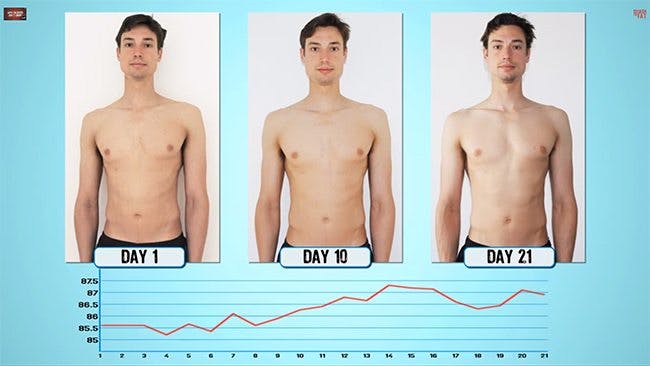
The young man Sam Feltham has done a three-week experiment, where he’s been eating enormous amounts of LCHF-food. On average 5794 calories daily of which “only” 10% as carbohydrates (menu).
According to over-simplified calorie counting, energy expenditure isn’t affected by what you eat. All excess calories you eat will then lead to weight gain. If this were true Feltham would have gained 16.5 lbs (7.5 kg) during the three weeks, but in reality he only gained 3.5 lbs (1.7 kg).
Here’s the explanation:

Theory and Reality

There’s a difference between calculated energy surplus and real energy surplus. Apparently Feltham didn’t have a large real energy surplus, as he didn’t gain more weight.
The most likely explanation to me is that his energy expenditure increased substantiallyduring the experiment. Maybe there are other explanations? Perhaps his body also adapted by not taking up all the nutrients he ate?
I’m not surprised by the results. If you starve long term you don’t lose as much weight as simple calorie counting predicts. The body will decrease the metabolic rate. If you overeat you don’t gain that much weight. The body adapts and tries to maintain an appropriate fat mass.
Some find it hard to believe in Felthams results and suggest that he’s lying. I don’t think so. There are several previous reports from people who have done similar experiments – stuffed themselves with copious amounts of LCHF-food. Weight gain tends to be small or non-existent, so Feltham’s results seem to be typical.

Hormones

The above applies as long as the body’s hormonal regulation is balanced. Eating large amounts of bad carbohydrates may interfere with hormonal balance. Large amounts of the fat-storing hormone insulin are then produced.
So what happens when you overeat bad carbohydrates to the extreme? A good example is the movie “Supersize Me”.
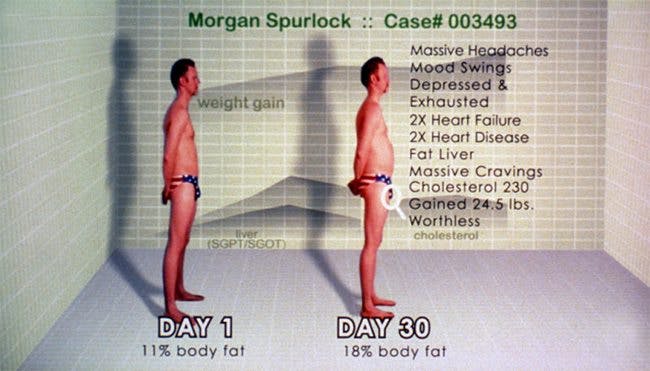
Morgan Spurlock did a similar experiment: he ate 5,000 calories daily for 30 days – at McDonalds. The difference was that this was not an LCHF diet, but HCHF (high carb high fat). There were about as many “excessive” calories, but Spurlock did not only gain 3.5 lbs (1.7 kg). He gained a whopping 24.5 lbs (11.1 kg).
spurlock
Professor Fredrik Nyström did a study where twelve students overate, but to a less extreme degree, “only” a few thousand extra calories daily in the form of carbohydrate-rich fast food, for four weeks. Just adding these extra calories made them gain on average 14 lbs (6.4 kg).
Paulo Roberto, Sweden, made a similar TV documentary the other year. He ate large amounts of carbohydrate-rich junk food and gained 33 lbs (15 kg) in two weeks!

Summary

There is a difference between overeating and overeating.
When eating bad carbohydrates it’s easy to gain weight quickly. You’ll get plenty of the fat-storing hormone insulin in your blood.
It’s generally hard to gain weight on an LCHF diet. It’s even difficult to eat too much food, as you then usually have to eat more than you want. Even if you force down large amounts of LCHF-food, against your will, the result is usually as it was for Feltham. It’s a constant struggle and weight gain will likely be modest.
Overweight people eating as much as they want on an LCHF diet will typically lose weight.
What do you think about the experiments?

Saturday, 4 October 2014

Benefits of Eating What’s in Season

Friday, 3 October 2014

60-gram Carb Diet

by Aglaee Jacob

Most people should consume 225 to 325 grams of carbs a day, based on a 2,000-calorie diet, according to the "2010 Dietary Guidelines for Americans." However, this may be too much for people dealing with insulin resistance and obesity, according to Dr. Stephen D. Phinney, co-author of "The Art and Science of Low-Carbohydrate Living." Low-carb diets require between 20 grams to 100 grams of carbs per day, but 60 grams is a good target for many people. Consult a dietitian specialized in low-carb eating to determine the appropriate carb target for you.

Breakfast

To limit yourself to 60 grams of carbs a day, consume about 15 to 20 grams of carbohydrates at each of your three meals and between zero and 15 grams of carbs in snacks. Most standard breakfast meals, such as breakfast cereals, toasts and muffins, provide at least 60 grams of carbs. Stay away from foods containing flour and sugar and instead, base your breakfast on foods that contain very few carbs, such as non-starchy vegetables, animal protein and fats. For example, you could have an omelet with cheese and broccoli or fried eggs with avocado, cherry tomatoes and bacon slices. You can get up to 15 to 20 grams of carbs by including half an apple or 1/2 cup of full-fat plain yogurt mixed with 1 cup of strawberries. Although all fruits contain carbohydrates, limiting your serving size or opting for berries, which have the lowest carb content compared to all other fruits, will help you keep your carb intake low.

Lunch

To keep your carb intake around 15 to 20 grams for lunch, avoid high-carb sandwiches and frozen entrees. Bring your own salad including plenty of leafy greens and non-starchy vegetables along with satiating protein and healthy fats. For example, you can fill up a large container with lettuce, spinach, green onions and cucumber slices, add slices of chicken or beef and top with healthy fats from almonds and a vinaigrette made with macadamia oil and balsamic vinegar. Complete the meal with a serving of fruit or three to four squares of dark chocolate to meet your carb allowance.

Dinner

For dinner, combine any of your favorite non-starchy vegetables with a protein. For example, you could have salmon with Brussels sprouts or an Asian stir-fry of pork, onions, cauliflower and red bell peppers. Don't forget to incorporate fats by using coconut oil to cook your vegetables and protein, spreading butter on your vegetables or using full-fat cream to prepare a low-carb sauce. You can get your 15 to 20 grams of carbs by making homemade fries with about 1/2 medium sweet potato or treating yourself to 1.5 cups of mashed pumpkin mixed with butter and cinnamon for dessert.

Snack

Your snack options will depend on whether or not you still have room for a few more grams of carbohydrates. If you do, you can snack on 3/4 cup of pineapple chunks mixed with cottage cheese or 1/2 cup of full-fat yogurt mixed with 1/2 cup of blueberries. If you prefer to get your carbs at your meals, choose low-carb foods to snack on if you get hungry. Hard-boiled eggs, cheese or a tuna salad are good examples of snacks that will satisfy you without adding carbs to your diet plan.

Do YOU have the 'fat gene'? Discovery of protein that controls metabolism could lead to anti-obesity drug


A 'fat gene’ has been identified, bringing the possibility of an anti-obesity drug a step closer, scientists have revealed.

The protein, called IRX3, regulates metabolism and energy expenditure - and researchers found mice deficient in it are 30 per cent slimmer on average.
The study found the ‘slim mice’ weighed less despite eating the same amount and doing as much physical activity as their counterparts.

When fed a high-fat diet, mice without IRX3 retained the same weight and fat levels as on normal diets, whereas others given the same food gained almost twice as much weight.
Fat cells in IRX3-deficient mice were smaller and increased levels of brown fat - which burns up unhealthy white fat - were observed. 

In addition, these mice were better able to process glucose.

Professor Chin-Chung Hui, of the University of Toronto, said: ‘These mice are thin. They lose weight primarily through the loss of fat. But they are not runts.

‘They are also completely resistant to high-fat diet induced obesity. They have much better ability to handle glucose - and seem protected against diabetes.’

The researchers said IRX3 interacts with another gene known as FTO which for some time has been known to be the most strongly related to being overweight.

Scientists say people carrying variants of this gene produce more of IRX3 - revealing a possible cause of obesity.
Professor Marcelo Nobrega, of Chicago University, said: ‘IRX3 is probably a master regulator of genetic programmes in the cells where it is expressed.

‘We're interested in what its targets are and what they alter. The goal is to identify downstream targets of IRX3 that become models for drug targeting.’

Researchers showed the connection between IRX3 and FTO occurs in humans, mice and zebrafish - suggesting an evolutionary link across different species going back thousands of years.
The study, published online in Nature, implies variants in FTO regulate obesity-related traits through links with IRX3 - identifying it as the likely ‘fat gene’.

Professor Nobrega said: ‘Our data strongly suggest IRX3 controls body mass and regulates body composition. Any association between FTO and obesity appears due to the influence of IRX3.’

Tests on mice showed IRX3 interacts with FTO even though its locality on the genome is a long way away. 
An analysis of a human genetic database then found the same thing happens in people which was confirmed in experiments on human cells in the lab.

Using data from 153 brain samples of Europeans the researchers then discovered the mutations to FTO affecting body weight are associated with IRX3 expression.

Obesity-related FTO variants enhanced the expression of IRX3 but did not seem to play a direct role in this interaction themselves.

The researchers also discovered mice with altered IRX3 function in the hypothalamus - the portion of the brain known to regulate feeding behaviour and energy expenditure - showed an identical pattern of leanness as those which completely lacked the gene.

So hypothalamic function of IRX3 seems to control body mass and composition in these animals - indicating the genetic predisposition to obesity is wired in the brain.

IRX3 codes for a protein that regulates other genes and is present both in and outside the brain, in organs and cells such as fat cells.

Professor Nobrega and colleagues are currently investigating how IRX3 interacts with genes and molecules it regulates and hope to identify targets for the development of drugs against obesity and diabetes.

Wednesday, 1 October 2014

Beetroot's health benefits

by www.lovebeetroot.co.uk/


Not only is beetroot great for boosting stamina and making muscles work harder, it also contains potassium, magnesium and iron as well as vitamins A, B6 and C, and folic acid.
Raw beetroot (100g) provides:
Per 100gGDA*
Energy162 kJ / 38 kcal2%
Proteing1.74%
Carbohydrate
of which sugar
of which starch
g
g
g
7.6
7.0
0.6
3%
8%
Fat
of which saturates
g
g
0.1
0.0
0%
0%
Fibreg1.98%
Sodium
Equivalent as salt
g
g
0.1
0.17

3%
*Recommended Daily amount (GDA) average adult (woman)
Source: McCance & Widdowson 6th edn.
Per 100gGDA
Vitamin C8%
Folic Acid (Folate)75%
Potassium (K)11%
Iron (fe)7%
Zinc (Zn)3%
Magnesium (Mg)4%
Beets also contain carbohydrates, protein, powerful antioxidants and soluble fibre. What’s more, just three baby beetroot equal one of your recommended five portions of fruit and vegetables a day.
Read on to find out more about how ruby red beets can help you maintain a healthy lifestyle...

Reduces blood pressure and the risk of heart attacks and strokes

Research has shown that beetroot can help reduce blood pressure as well as its associated risks such as heart attacks and strokes. This is because the high content of nitrates in beetroot produce a gas called nitric oxide in the blood which widens blood vessels and lowers blood pressure. A daily dose of 250ml of beetroot juice or 1 to 2 cooked beetroot (approx. 100g) can help dramatically reduce blood pressure and its associated risks. For more information on heart health, help, facts and lifestyle advice, visit the British Heart Foundation.

Powerful antioxidant properties

Betacyanin, the pigment that gives beetroot its colour, is also an antioxidant. Antioxidants are believed to help reduce the oxidation of LDL cholesterol, in turn protecting artery walls and reducing the risk of heart disease and stroke.

Folic acid

Beetroot contains folic acid which is essential for normal tissue growth. Folic acid is crucial to the development of a baby’s spinal cord during the first three months of pregnancy and can help prevent spinal cord defects such as spina bifida. Beetroot also contains iron so is a fab pick-me-up for mums-to-be suffering from fatigue during pregnancy. Expectant mums must remember though that cooked beetroot has lower levels of folic acid than raw beetroot. For more information on the importance of folic acid during pregnancy, visit the NHS website. For more information on foods containing folic acid see Bounty’s Folic Acid Factfile.

Reduces risk of osteoporosis

Beetroot contains the mineral silica. This helps the body to utilise calcium, which is important for musculo-skeletal health and reducing the risk of osteoporosis.

Lowers cholesterol

Beetroot contains soluble fibre, which has also been shown to have cholesterol lowering capabilities. It also contains carotenoidsand flavonoids, which help prevent LDL or ‘bad’ cholesterol from being oxidised and deposited in the arteries.

Stabilises blood sugar

Since Roman times, beetroot has been viewed as an aphrodisiac. Beetroot is virtually fat free and low in calories. Although it has a 'medium' GI (Glycaemic Index) of 64, It has an extremely low GL (Glycaemic Load) of 2.9 which means it’s converted into sugars very slowly and therefore helps to keep blood sugar levels stable.

Treats anaemia and fatigue

Beetroot’s iron content means it’s good for those with anaemia and fatigue.

Helps slow progression of dementia

A recent study by Wake Forest University in North Carolina, USA has shown that the high content of nitrates in beetroot may also help fight the progression of dementia, as nitric oxide in the blood (produced by the nitrates in beetroot) also helps increase blood flow to the brain. Beetroot’s folic acid may also play a part as studies suggest it can help protect against Alzheimer’s and dementia.